Learning to play again
GOOOAAAALLLLLLL!!!!!
I laughed as we finally scored. I slapped the boy’s hand with a huge high-five, and ran back to celebrate with the goalkeeper.
We laughed.
We had fun.
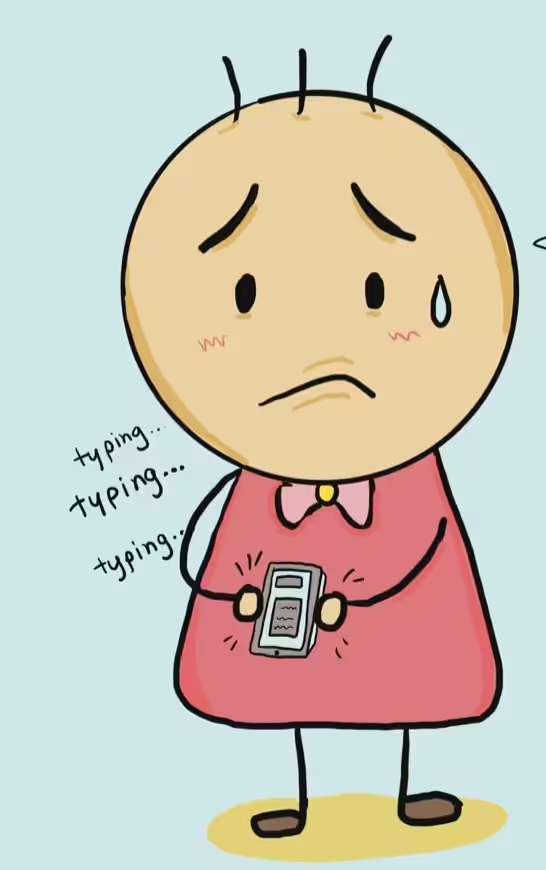
That seemed so alien, so faraway, from the work I had been doing just 23 minutes ago, at my desk. I had been persistently looking at the clock, wondering when it would be time to go home.
I was tired of the same work, the same administrative tasks, the same old.
As a young adult today, you might wonder:
Is this it? Did I study so hard, for 15 years, to do this? For the next 45 years?
Am I working so hard, day after day, just for this?
No one ever told me that work would be this BORING!
How do you find joy as a young working adult?
The transition from studying to work can be one of the hardest, especially when you are so used to fun. Finding your joy again does not need to be painful.
It can be fun. But it requires us to look at why work doesn’t seem to work.
Why it used to be fun
Look back at your studying days.
What do you recall?
Spontaneous outings with friends.
Strange jokes that had you stitched up in laughter for hours. You might stop laughing, but then you catch your friend’s eye in the lecture… And you start laughing again.
Work… that wasn’t so consequential. At the very most, if you failed an assignment, you work harder for the next term. At work, you mess up… that’s it.
As faraway as studying seemed to be, it used to be fun. Why?
Did we work so hard to get into joyless jobs?
As Vicki Robin asks in her book, Your Money or Your Life,
Are you making a living, or making a dying?
Freshness built in
The nature of study has spontaneity built in. Work doesn’t.
Studying can sometimes be boring. But for the most part, studying is about discovery. In school, variance is built into the lessons.
Yes, I know there are boring lectures and seminars. You might even be sitting through one, whilst reading this article.
But variance is also built in through the anchors of seminars and lectures.
It’s built in through the fact that you will always have new learning opportunities around the school. You’re forced to work in new project teams. Every few months, you get a new lecturer.
You get new:
- Events
- People/ Relationships
- Learning opportunities
You keep getting new things. You never know what’s next.
Work, on the other hand, is about ensuring stability. It’s about consistency. It’s about ensuring that your customers get what they want, on time, on target. If you can throw out the uncertainty with it, that’s the way to go.
Spontaneity built in
With school, you didn’t have to go for lessons! You could watch a recording if you missed one. That gave you the freedom and flexibility to do whatever you want, whenever you want.
You may have been used to skipping school, going to the local café for fun.
Work isn’t the same.
You probably are told some version of this:
- Ensure that you’re accountable to your calendar.
- Ensure that you answer calls and messages promptly.
- Answer your emails in X hours.
During the great work-from-home experience, I’ve heard stories of employees needing to schedule meetings throughout the day to look like they are working.
One clever friend ended up calling herself with another computer, so that she could look like she was busy… and not get disturbed whilst getting the real work done.
Work ends up being disengaging, because, you don’t have the spontaneity to do whatever you want, whenever you want.
Light-heartedness built in
When you start working, you start seeing numbers and figures you never touched before in your life.
In a single hour, you might see more money pass through your computer terminal than you’ve ever seen pass through your life.
You might be asking for transactions that cover the entire length of your work life.
It’s serious.
Study…is not that serious. Things seem to be a conceptual exercise, with little real consequence.
That’s the difference.
When you make a mistake at work, it could cost you seriously. Especially when you’re saving for a home, you can’t afford to have mistakes that cost you your job.
How do you change this?
Let go of the need to perform
I’ll admit. I’m a self-development addict. I pay thousands of dollars each year to get better through courses, books, and training to learn how to run a business. When someone asks me to go out for a $3 coffee, I hesitate.
Because coffee is too expensive.
Yes, I do know that I did eventually form one of the better annual report design agencies, even one that was award winning like Media Lede, but did it matter if I had few friends?
What have I realised?
There’s no point to self-development if it’s another performance treadmill you’re getting on. You’re swapping your promotion treadmill at work for a performance treadmill in your personal life.
In work, there are so many ways to get ahead.
You’re asked to go for course after course for continuous, lifelong learning. You’re told that you need to up-skill, upgrade, to prevent yourself from being left behind.
You begin to wonder if the treadmill will ever stop.
Learning no longer becomes a joyful pursuit of passion. It mutates into a joyless performance for paper qualifications.
Expanding your knowledge in your field of work is important to help you gain greater competence and a feeling that you’re getting better.
But learning something that you’ve always wanted to learn, whether or not it contributes to your career, also has merit.
It gives you the chance to meet new people, to realise that learning is (GASP!) not tied to performance, and that it can be fun.
Pick something you’ve always wanted to learn. Something outside your traditional field of work.
And have fun with it.
Joy comes through relationships.
When you’re spending so much time with colleagues, you might hesitate to spend more time with friends.
When you were at school, there wasn’t so much to be mindful of in your work relationships. Friends, were… just friends. They wouldn’t pick on what you said and report it to your boss, or wonder if you were talking ill of them behind their backs.
But colleagues may be different. There may be an element of politicking from the ‘non-work’ interactions you have.
I’m not a relationship expert. I’ve made many mistakes with friendships, and lost my fair share of friends over the years. But I’ve learnt one thing.
Joy looks for you when you engage in relationships.
Especially in groups of more than 3. Do something creative together, like cycling, walking, or baking.
There’s much joy that can be had in those occasions.
Contribute
In Singapore, as young students, we were asked to volunteer through the Community Involvement Programme (CIP). At that time, we had to fulfil 20 hours a year contributing to the community through volunteer projects at places like the elderly homes, or distributing meals, or teaching disadvantaged children. Some students found it a hassle.
I always wondered why we were asked to do that. Wasn’t there enough homework to do, without thinking of what the next song to sing for the elderly would be?
But now? I don’t. I realise that those occasions helped me to be thankful, and to realise that my work wasn’t about me. It was about something greater than me.
That there was more to life than getting my paycheck, promotion, and plushy toys.
Today, you have some skills. Use them to contribute in other areas of work.
For example, despite facing initial revenue difficulties running a content agency, we did a low bono project for Allkin, charging way below the market rate to make it work for both of us.
Grow in other areas
You might well ask: John, you were a social worker that was always looking for the best charities to work in. How did you go from that to doing a content agency? Well, part of that came from learning content marketing, website-making, and PR, on my own. I didn’t want to sit on my hands and just hate my social work job (at that time), having to struggle through more paperwork.
I wanted to keep doing more.
So I paid for courses, went for lessons, just so that I could keep growing.
Appreciate the small moments
That evening, as I walked home after the football match, I realised that was the first night that I had done something spontaneous. Unplanned. Something that wasn’t on the diary.
The danger of ‘adulting’ is that everything becomes rigid, fixed, and planned. Before you meet someone, you need to book them on their diary.
I’m not saying that’s not important. But I’m saying that sometimes, life’s joys come outside the diary.
They come outside the planned interactions that we have. Outside the plans we have to upskill, upgrade, and move upwards in our careers.
They come in the small, magical moments.
Catch them. Amplify them. Don’t let them go.
Lift your head to the sky, breathe, and smile. Life isn’t all about work.
By-line
John loves dogs. He is excited about young people living with purpose and passion at liveyoungandwell.com.